
Medication tapering guide
How to taper off vortioxetine (Trintellix) — a guide to gradual reduction
Vortioxetine (Trintellix; Brintellix in the UK and EU): why not to stop it all at once, which withdrawal symptoms to expect, what hyperbolic tapering looks like and what to ask your doctor. An educational guide, not dosing instructions.
Important: PsyLab is not a medical practice. This guide is educational and does not replace a doctor. Never stop or reduce a medication without agreeing it with your prescribing doctor or psychiatrist. Specific doses and pace are always set by them.
Vortioxetine — sold as Trintellix; Brintellix in the UK and EU — is an antidepressant (multimodal). If you have been taking it for a while and are considering a gradual reduction or stopping it together with your doctor, this guide explains why the pace matters and what to prepare for.
Vortioxetine at a glance
| Active substance | Vortioxetine |
|---|---|
| Brand names | Trintellix; Brintellix in the UK and EU |
| Class | multimodal |
| Half-life (approx.) | long, about 66 h |
| Withdrawal risk* | lower |
* A rough guide based on half-life and published observations. It can differ a lot between individuals — it also depends on how long you have taken it and on past experience with stopping.
Why not stop it all at once
While you take the medication, the brain adapts to it — it changes receptor sensitivity and its own production of neurotransmitters. When the drug disappears suddenly, these adaptations persist for weeks to months, creating an imbalance that shows up as withdrawal symptoms. In a systematic review by Davies and Read (2019), more than half of people stopping an antidepressant experienced them.
Vortioxetine has a long half-life, so levels fall slowly when the dose is reduced. In clinical trials, withdrawal symptoms on stopping were less frequent than with many SSRIs — but that does not mean everyone will taper without difficulty.
What a gentle taper looks like
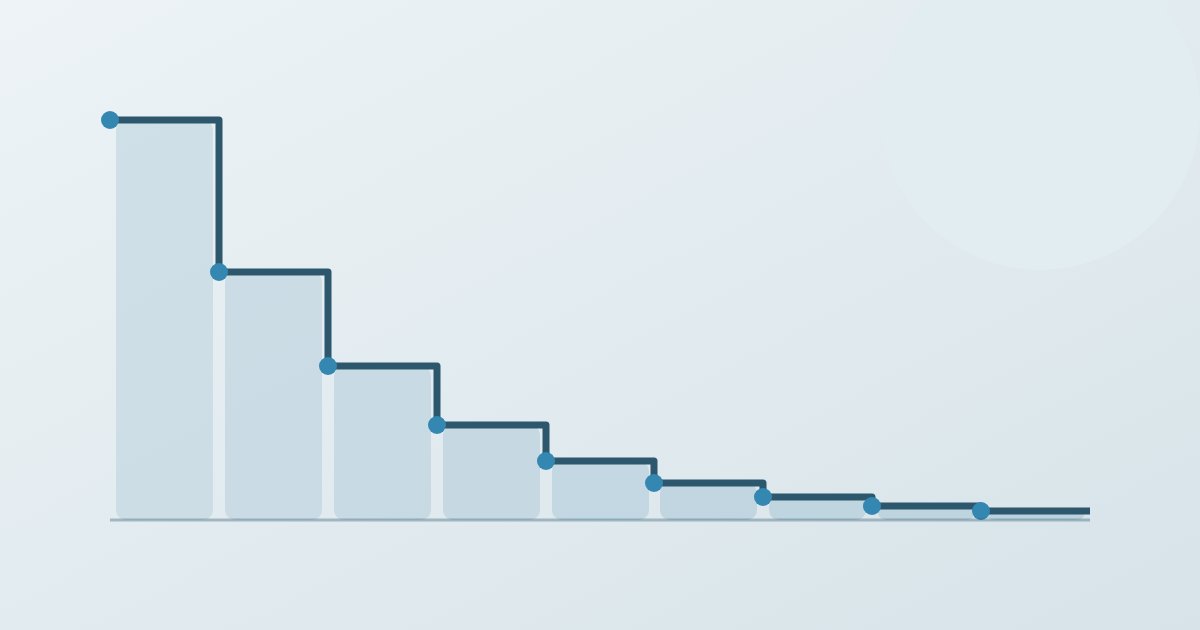
Horowitz and Taylor (2019) recommend hyperbolic tapering: each step is calculated from the current dose, so steps start larger and become progressively smaller. The next step follows only once things have settled — usually after a few weeks. If symptoms are strong, it is fine to pause longer or go back up a little.
Hyperbolic tapering: steps get smaller towards the end
Serotonin transporter occupancy: vortioxetine
For a detailed explanation with charts — how the drug occupies the serotonin transporter and why the last step is the biggest — see How to taper off antidepressants.
Withdrawal symptoms: vortioxetine
They most often appear within a few days of a dose reduction:
- dizziness and “brain zaps” (brief electric-shock sensations)
- nausea, flu-like feelings, sweating
- anxiety, irritability, mood swings, tearfulness
- insomnia, vivid dreams or nightmares
If symptoms do appear, they may come later than with short half-life drugs, so it is worth monitoring yourself for several weeks after each step.
Withdrawal or relapse?
Withdrawal symptoms usually appear within a few days of a reduction, have a physical component (dizziness, “zaps”, nausea) and often ease quickly if you return to the previous dose. A return of depression or anxiety tends to come gradually, over weeks, and resembles your original problems. It is not always easy to tell apart — so keep a short symptom diary and go through it with your doctor.
Practical notes on the formulation
An oral-drops formulation is authorised in the EU, which allows fine steps. A pharmacist can check whether it is available where you live.
Never modify tablets or capsules on your own. If smaller doses than those on the market are needed, a doctor can prescribe a medicine made up individually by a pharmacy.
What to ask your doctor
- Is now a good time to reduce? (a stable period, without big life changes)
- How big will the first step be, and how long will I stay on it?
- How will we handle the lowest doses — is there a liquid form or a pharmacy-made option?
- What should I do if strong symptoms appear — slow down, or go back a step?
- How often will we check in?
Guides for other medications
Sources
- Horowitz & Taylor (2019) — Tapering of SSRI treatment to mitigate withdrawal symptoms, Lancet Psychiatry
- Davies & Read (2019) — A systematic review into the incidence, severity and duration of antidepressant withdrawal effects, Addictive Behaviors
- Sørensen, Ruhé & Munkholm (2022) — The relationship between dose and serotonin transporter occupancy of antidepressants, Molecular Psychiatry
- Summary of Product Characteristics (SmPC) — half-life, formulations and warnings on stopping treatment
Next step
When planning a gradual reduction, we can help you prepare questions and notes for your doctor.